Choose between source-backed Metri-Pack 150 and 280 parts, then match the housing, contact gender, cable outside diameter, seal, cavity plug, and assembly direction.
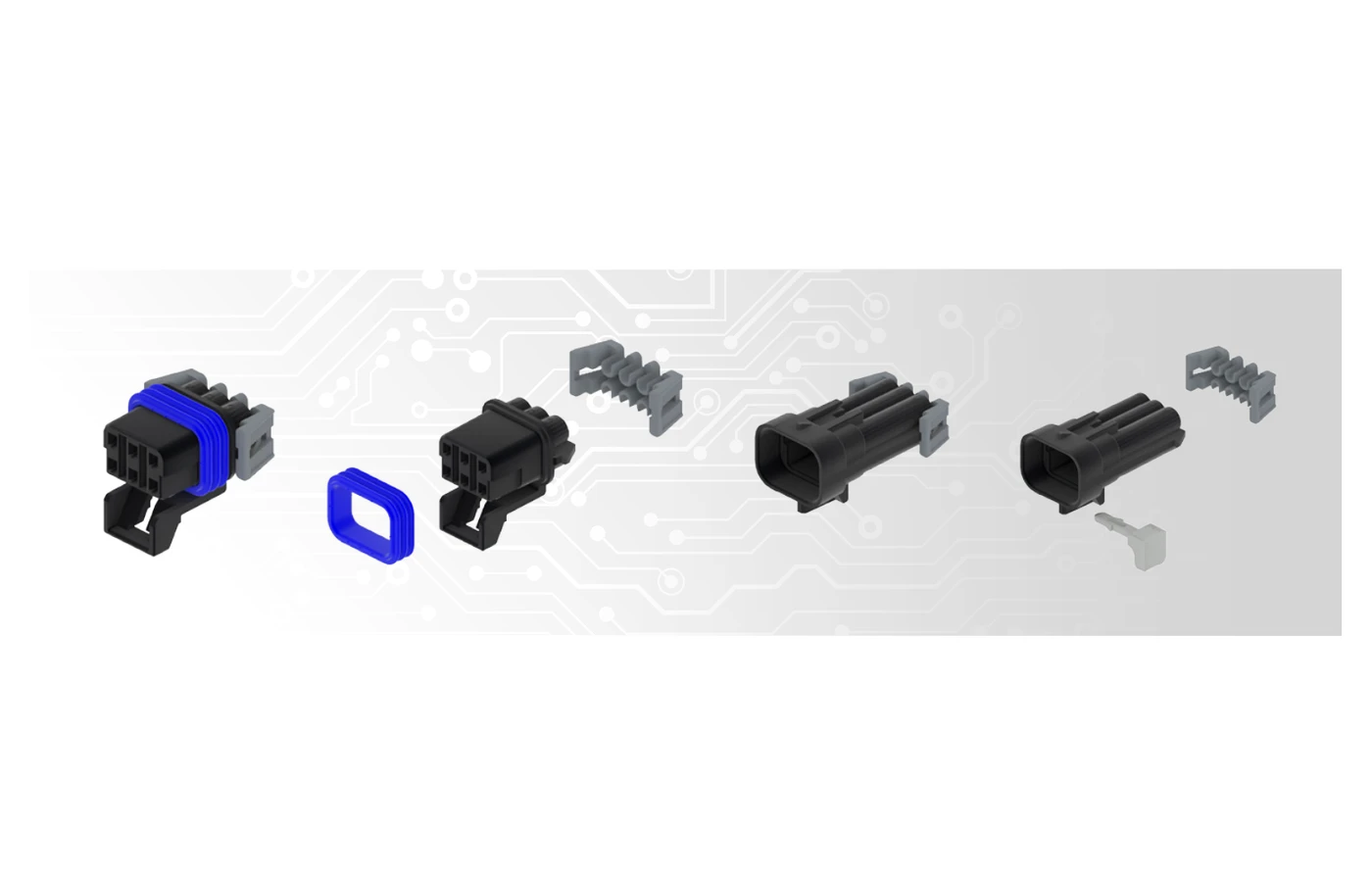
Manufacturer-authored illustration from the Aptiv Metri-Pack 150 Sealed Series datasheet. Product geometry is not redrawn.
150 and 280 selection setSealed cable-mount housingsTerminal and seal matchingQuote-led assembly support
Family ladder
150, 280, 480, and 630 describe different interfaces
Aptiv's Metri-Pack ladder spans 150, 280, 480, and 630 series. Moving up the ladder changes terminal blade size, housing geometry, seals, and tooling; it is not simply a current-rating choice. The selection tables below cover only 150 and 280 because those are the exact catalog-backed parts included in this guide.
Metri-Pack 150
Compact 1.5 mm interface
Aptiv's current sealed-series sheet specifies -40 to 125 C and SAE J2030 S3 high-pressure spray performance for the tested system. Those conditions do not establish a universal enclosure rating for every assembly.
Metri-Pack 280
Larger 2.8 mm interface
Use 280 housings only with their exact mating half, compatible 280 terminals, cable seals, cavity plugs, and secondary locks. Do not infer compatibility from a similar black housing or the Metri-Pack name alone.
Housing part-number maps
Release the exact MPN. Position count, contact gender, keying, cable exit, sealing hardware, and mating role all matter.
Metri-Pack 150 retained set
Cavities
Female housing
Male housing
Selection note
2
12052641
12162000
Inline pair
3
12110293
12129615
12059595 is an alternate female housing
4
12162144
12162102
Inline pair
6
12052848
12124107
Inline pair
8
12047937
12047931
Inline pair
Metri-Pack 280 retained set
Cavities
Female housing
Male housing
Selection note
2
15300027
15300002
Inline pair
3
12040977
15300003
Inline pair
4
12129565
12129600
Inline pair
6
12059573
Device mate
Confirm the device-side interface
Metri-Pack 150 contacts and seals
Confirm both conductor range and cable outside diameter. A contact that fits the conductor can still be wrong for the insulation or selected cable seal.
Role
MPN
Wire
Insulation OD
Pin
12045773
20 to 18 AWG
1.69 to 2.78 mm
Pin
12077628
22 to 20 AWG
1.47 to 2.40 mm
Socket
12048074
20 to 16 AWG
2.03 to 2.80 mm
Socket
12084200
22 to 20 AWG
1.30 to 2.20 mm
Cable-seal set
15324973 - 2.03 to 2.85 mm
15324976 - 1.60 to 2.15 mm
15324974 - 1.20 to 1.70 mm
12084193 - 0.995 to 1.009 mm
Use cavity plug 12059168 in unused positions where specified.
Metri-Pack 280 contacts and seals
The compatible-contact map is housing-specific. The safe OD bands below are the continuous ranges used for this retained component subset.
Role
MPN
Housing use
Insulation OD
Socket
12077411
12040977
2.03 to 2.90 mm
Socket
12077412
15300027, 12129565, 12059573
2.48 to 2.90 mm
Pin
12048159
15300002, 15300003, 12129600
2.03 to 2.90 mm
Match cable seal 15324982 to the actual cable OD and use cavity plug 12010300 in an unused position where the exact housing drawing calls for it.
Push-to-seat and pull-to-seat are not interchangeable instructions
Push-to-seat
Insert the crimped terminal from the wire side and push it forward until the primary lock engages. Verify retention with the applicable drawing and a gentle rearward check before installing the secondary lock.
Pull-to-seat
Route the un-terminated lead through the housing from the mating side, crimp the specified terminal, then pull the lead back until the terminal locks. Do not substitute a push-to-seat service procedure.
Metri-Pack questions
What is the difference between Metri-Pack 150 and 280?
The series names track different standardized blade sizes: 150 uses a 1.5 mm interface and 280 uses a 2.8 mm interface. Their housings, terminals, seals, and tooling are series-specific, so the larger number is not a drop-in upgrade.
Are all Metri-Pack connectors assembled the same way?
No. A push-to-seat design accepts the terminated lead from the wire side. A pull-to-seat design routes the lead through the housing before crimping and then seats the terminal by pulling it back. Follow the exact housing and terminal drawing rather than a family-wide assumption.
How do I choose a Metri-Pack cable seal?
Use the finished cable outside diameter, not conductor gauge alone. Confirm that the selected terminal's insulation-grip range and the cable seal's published range both contain the actual cable OD.
Does a sealed Metri-Pack housing have a universal IP rating?
No universal rating is stated here. Environmental performance depends on the exact housing system, contacts, cable seals, cavity plugs, assembly quality, mating engagement, and the manufacturer's applicable test conditions.
Join our community and be the first to know about the latest in wire harness prototyping. Get exclusive insights, tips, and updates delivered straight to your inbox.
Latest Prototyping Trends
Stay ahead in the field with our articles on MiniProto updates, new technologies, design tips, and industry insights.
No Spam, Only Value
We respect your inbox. Receive only the most relevant updates and offers, without the clutter of unwanted emails.